How much should we have in the reserve fund? I’ve heard various answers. Some give an absolute amount. ($X million.) Others base it on total budget. (X% of the overall budget.) Neither is a good answer.
The problem with any arbitrary standard is that it depends on what you’re expecting to spend in the future, both near and far. $2 million might sound like a lot, but it’s not if you know you’ll need to do $3 million in infrastructure work in the next year. $500k might seem like too little, but it might not be if you anticipate no big expenses for the next five years. (So that there’s plenty of time for regular transfers into the fund to build it back up again.) The real answer is complicated: it depends on your projected expenses.
Here’s a chart from the 2025 Reserve Study tracking the reserve fund over the next 30 years:
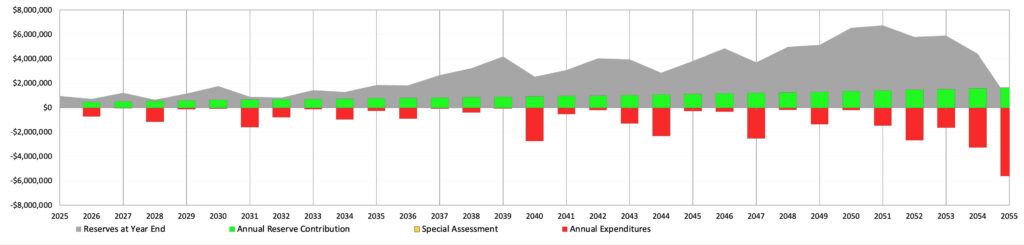
The green bars are annual transfers to the reserve fund. Notice that they grow slowly to account for inflation (and also, for the next few years, by an extra amount to account for the fact that, from 2014-2023, we only transferred half of what we should have into the fund, so now we have to spend some years building it back up extra fast.)
The red bars are projected capital expenses. Notice that some years there’s hardly any spending, while in other years, it’s huge. This is the nature of infrastructure work: it’s not something you have to deal with every year, but when you do, it’s usually something big.
The important thing is for the green bars to add up to enough to cover all the red bars over the course of the next 30 years, and this is shown by the gray area, which is the size of the reserve fund at any given time. Notice that it gets pretty low at times, and at other times it gets really big. That’s because of how uneven the expenses are. The important thing is that the balance always stays above zero.
As long as we stay faithful to this schedule, it would be a mistake to panic when the fund gets low and increase our transfers, and also a mistake to think we can reduce our transfers when the fund gets big. The recommended transfers are exactly what we currently need to match our predicted expenses over the long haul.
Now, it’s always possible that conditions will change. Unexpected expenses — or savings — could occur. For this reason, it’s important to do a new reserve study every 3-5 years, and sometimes, we might need to make adjustments on our own between studies. But the most important thing is to have that long-term view in the first place.